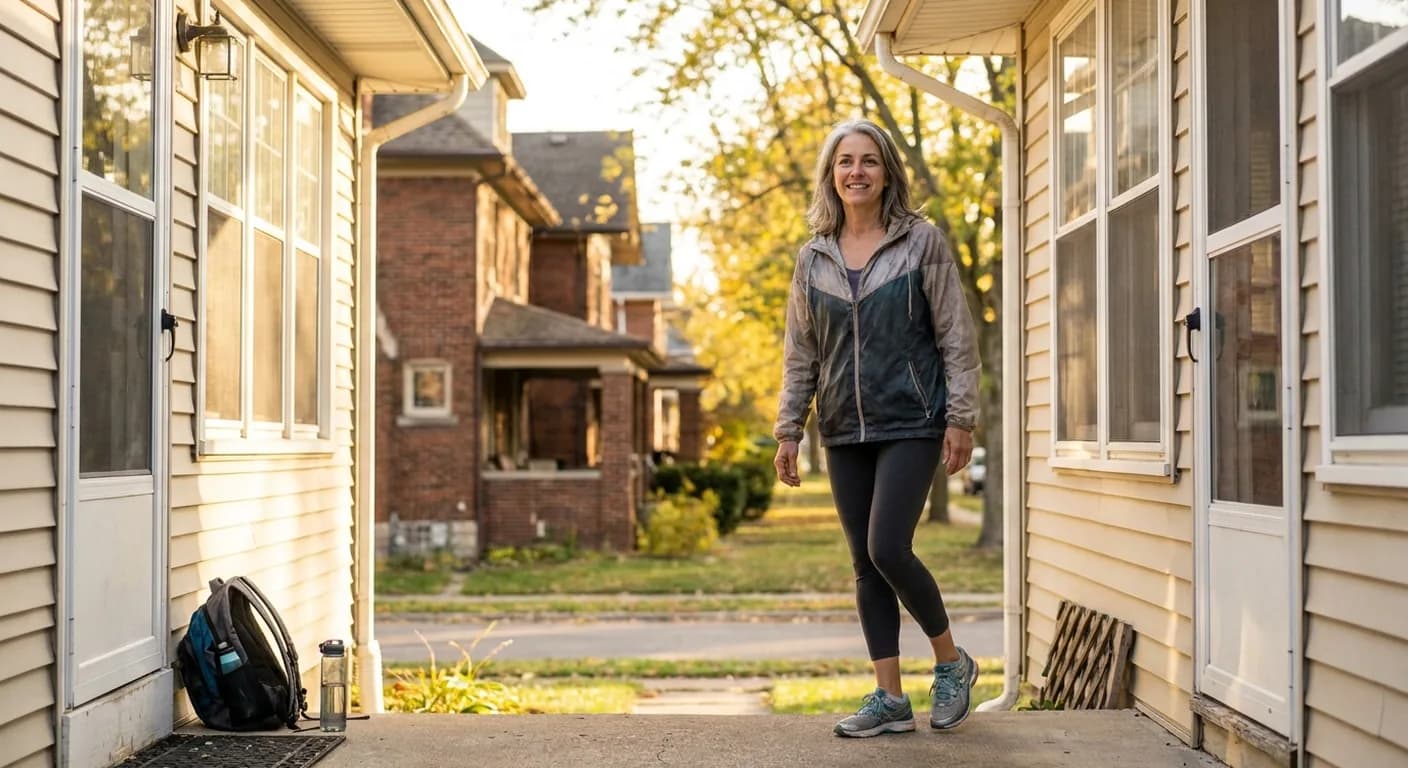
If you've been thinking about running but the idea of actually running feels impossible, this couch to 5K plan is for you. It takes you from your first one-minute jog to running 30 minutes straight in nine weeks, using three short sessions a week. No fitness required to start. No judgment about where you're starting from.
We coach women through this exact journey every day, most of them beginners in their 40s, 50s, and 60s. So this isn't theory. It's the plan we actually use, plus the honest advice the classic programs leave out: what to do when you're over 45, when you're carrying extra weight, and when a week simply feels too hard.
Note: If you have a heart condition, joint problems, or you've been inactive for years, check in with your doctor before you start. It's almost always a green light, but it's worth the five-minute conversation.
How this couch to 5k plan works
The magic of couch to 5K is that it never asks you to do something your body isn't ready for. You alternate short runs with walking breaks, and each week the runs get a little longer while the walks get a little shorter. By week 7 you're running continuously, and by week 9 you're running for 30 minutes. The run and walk approach is so well proven that the UK's health service built its own free NHS Couch to 5K program around exactly this structure, and millions of new runners have finished it.
Three rules make the whole thing work:
- Three sessions a week, never back to back. Your muscles, tendons, and bones adapt on rest days, not run days. Monday, Wednesday, Saturday is a lovely rhythm, but any spacing works as long as you rest between sessions.
- Everything is measured in time, not distance. You never need to hit a pace or a mile marker. A slow 3 minutes counts exactly the same as a fast one, and slow is genuinely better for building the habit.
- Every session is wrapped in walking. Start with a 5-minute brisk warmup walk and finish with a 5-minute easy cooldown walk. They're not optional extras. They're what keeps your calves and knees happy.
The 9 week couch to 5k schedule
Here is the full week-by-week schedule. Every session begins with a 5-minute brisk warmup walk and ends with a 5-minute cooldown walk, so a typical session takes 30 to 40 minutes door to door.
| Week | Session 1 | Session 2 | Session 3 |
|---|---|---|---|
| 1 | Run 1 min, walk 2 min. Repeat 7 times. | Run 1 min, walk 2 min. Repeat 7 times. | Run 1 min, walk 2 min. Repeat 7 times. |
| 2 | Run 2 min, walk 2 min. Repeat 5 times. | Run 2 min, walk 2 min. Repeat 5 times. | Run 2 min, walk 2 min. Repeat 5 times. |
| 3 | Run 3 min, walk 2 min. Repeat 4 times. | Run 3 min, walk 2 min. Repeat 4 times. | Run 3 min, walk 2 min. Repeat 4 times. |
| 4 | Run 4 min, walk 2 min. Repeat 4 times. | Run 4 min, walk 2 min. Repeat 4 times. | Run 4 min, walk 2 min. Repeat 4 times. |
| 5 | Run 5 min, walk 2 min. Repeat 3 times. | Run 6 min, walk 3 min. Repeat 3 times. | Run 8 min, walk 3 min, run 8 min. |
| 6 | Run 10 min, walk 3 min, run 8 min. | Run 12 min, walk 3 min, run 8 min. | Run 15 min, walk 3 min, run 5 min. |
| 7 | Run 18 min continuously. | Run 20 min continuously. | Run 22 min continuously. |
| 8 | Run 24 min continuously. | Run 25 min continuously. | Run 26 min continuously. |
| 9 | Run 28 min continuously. | Run 28 min, easy and relaxed. | Run 30 min. This is your 5K day. |
A few notes on reading the table:
- Weeks 1 to 4 build your engine gently. The runs grow by a single minute per week. It will feel almost too easy some days. That's the point. Boring weeks now buy you injury-free weeks later.
- Weeks 5 and 6 are the bridge. The walking breaks shrink and the runs stretch out. The first 8-minute run is where most women realize they've quietly become someone who runs.
- Weeks 7 to 9 are continuous running. No breaks, but also no pressure on pace. Slower than you think you should go is exactly right.

Before week 1: the optional gentle start
If you've been fully sedentary for a year or more, if you're over 60, or if you're carrying a lot of extra weight, give yourself a pre-week (or two) before starting week 1. Walk briskly for 30 minutes, three times a week, until those walks feel comfortable rather than hard. In the femrun app we build this pre-week into the plan automatically for women who need it, because starting one rung lower is how you finish the ladder.
If even brisk walking feels like a stretch right now, begin with our walking to running program for beginners and come back to this plan when 30-minute walks feel easy. Nothing about that is falling behind. It's just entering the on-ramp where it meets your road.
Couch to 5k for beginners over 45
Most couch to 5K programs were written with a 28-year-old in mind. If you're 45, 55, or 65, the plan still works beautifully, but a few things deserve honesty:
- Recovery takes longer, so protect your rest days fiercely. At 50, the adaptation that took a day at 25 takes closer to two. Never trade a rest day for a catch-up run.
- Expect your joints to complain before your lungs do. Mild muscle soreness is normal. Sharp or persistent pain in a knee, hip, or shin is a signal to take two extra rest days, not to push through.
- Warmups matter more now. Don't skip the 5-minute walk, and add a few gentle leg swings and ankle circles before the running starts.
- Strength is your secret weapon. Two short sessions a week of squats, bridges, and calf raises will do more for your running than any gadget. From your mid 40s onward, muscle and bone respond wonderfully to this kind of loading, and it directly protects you from the most common beginner injuries.
Starting at a higher weight
Plenty of the women we coach start their couch to 5K at 200, 220, or 250 pounds, and they finish it. A few adjustments make the journey kinder:
- Take the pre-week seriously. Two or three weeks of brisk walking first lets your tendons and joints adapt to impact gradually.
- Repeat early weeks freely. Doing week 1 three times isn't slow progress. It is progress, on the schedule your body sets.
- Invest in cushioned shoes before anything else. They're the one purchase that genuinely matters. Our guide to the best running shoes for beginners will save you from the trial-and-error tax.
- Run on forgiving surfaces when you can. A dirt path, a track, or a treadmill is gentler on knees than concrete.
- Ignore pace completely. A 16-minute mile with running intervals in it is running. Anyone who says otherwise has never started from where you're starting.
Tip: Chafing is the unglamorous thing nobody warns you about. A cheap anti-chafe balm on inner thighs and sports bra lines before every run will spare you a lot of misery.
When a week feels too hard, repeat it
Here is the rule we give every woman we coach: if you finish a week feeling defeated instead of tired, do that week again. Repeat it as many times as you need. The nine weeks on paper are a suggestion, not a deadline, and stretching this plan to 12 or 14 weeks changes absolutely nothing about where you end up.
What repeating a week is not: failure, weakness, or evidence that you're "not a runner." Your cardiovascular system adapts in weeks, but tendons and bones take months. A repeated week is often your body cashing in the time it needs to rebuild stronger. The women who finish this program are rarely the fittest ones on day one. They're the ones who kept showing up, at whatever rung of the ladder they were on.
The only real failure mode in couch to 5K is quitting entirely because the schedule felt like a judge instead of a guide. Fire the judge. Keep the guide.

Tips to finish this couch to 5k training plan
After coaching thousands of first-time runners through this exact ladder, these are the things that separate finishers from week-3 dropouts:
- Schedule sessions like appointments. Decide tonight when your three runs happen this week and put them in your calendar. "I'll fit it in" is how week 3 becomes the last week.
- Slow down, then slow down again. Nearly every early dropout traces back to running too fast. If you can't speak a sentence, walk until you can.
- Never miss two in a row. One skipped session is life. Two is the start of a story about how you tried running once.
- Tell someone. A friend, a partner, a group chat. Accountability roughly doubles follow-through, which is exactly why coaching works.
- Mark the wins. First 5-minute run. First time week 1 feels easy. First continuous 18 minutes. These deserve more celebration than the finish line, because they're the ones that keep you moving toward it.
Couch to 5k plan FAQ
How long does a couch to 5k plan take?
Nine weeks if every week goes smoothly, and 10 to 14 weeks for many real humans with real lives. Both timelines end in the same place: you, running 30 minutes without stopping. Take the one your body votes for.
Will this couch to 5k running plan really get me to 5 kilometers?
The plan gets you to 30 minutes of continuous running. At a typical beginner pace that's roughly 4 to 5 kilometers, so some runners cross the 5K line a week or two after graduating (a 5K is 3.1 miles, and here's exactly how long a 5K is in every unit). Keep running three times a week and the distance arrives on its own. When you're ready to train for the distance itself, move on to our 5K training plan.
What if I can't run for even one minute?
Then you've found your starting rung, and it's a fine one. Swap week 1 for run 30 seconds, walk 2 minutes, repeated 8 times. Repeat that until it feels manageable, then join the schedule at week 1. Every runner you've ever admired started somewhere on this same ladder.
Can I follow this couch to 5k run plan on a treadmill?
Absolutely, and for many beginners it's the better choice: soft surface, no hills, no weather, total privacy. Set the incline to 1 percent to mimic outdoor effort. If your goal is an outdoor 5K event, move a session or two outside in the final three weeks so race day surfaces feel familiar.
What happens if I miss a week?
Missed a few days? Pick up where you left off. Missed a full week? Step back one week in the schedule. Missed two or more? Step back two weeks and rebuild. Fitness fades far more slowly than guilt suggests, and the plan doesn't care when you finish. It only cares that you do.